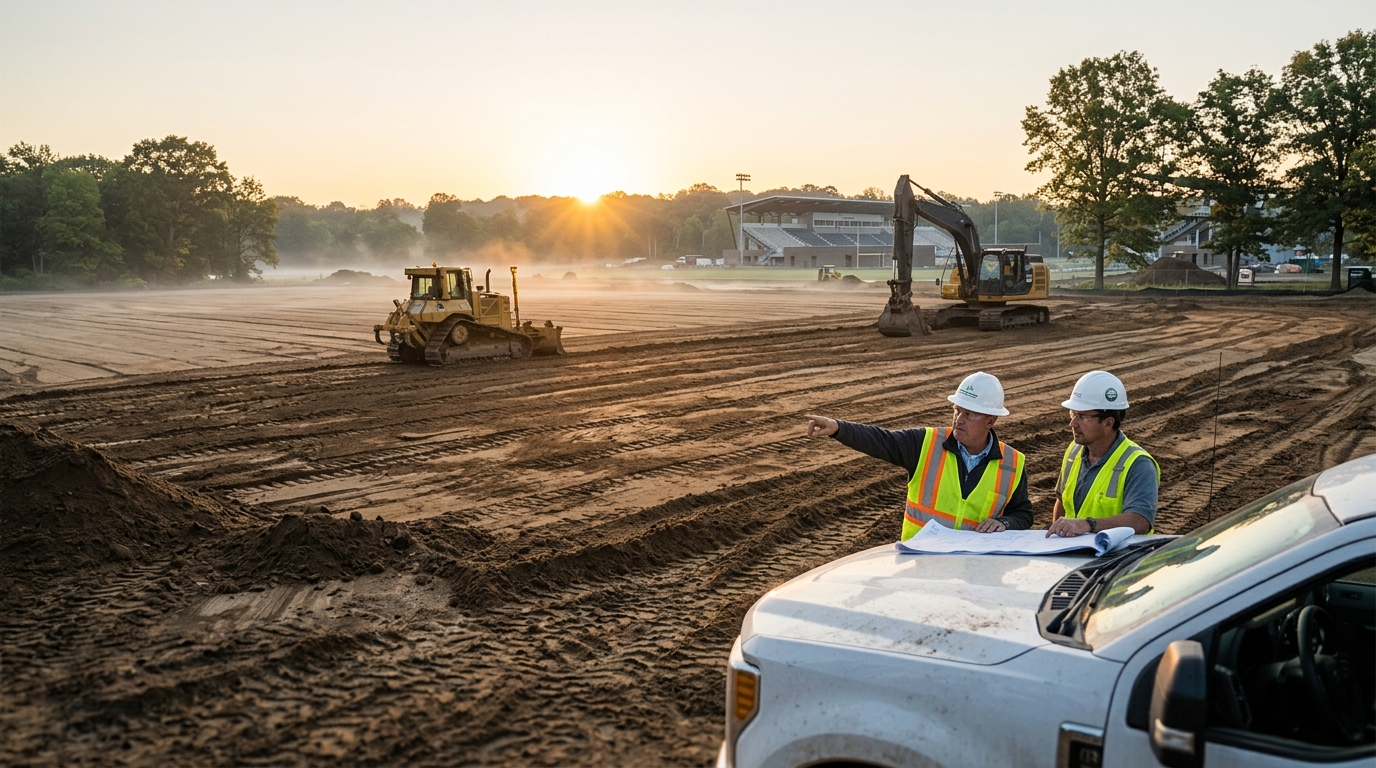
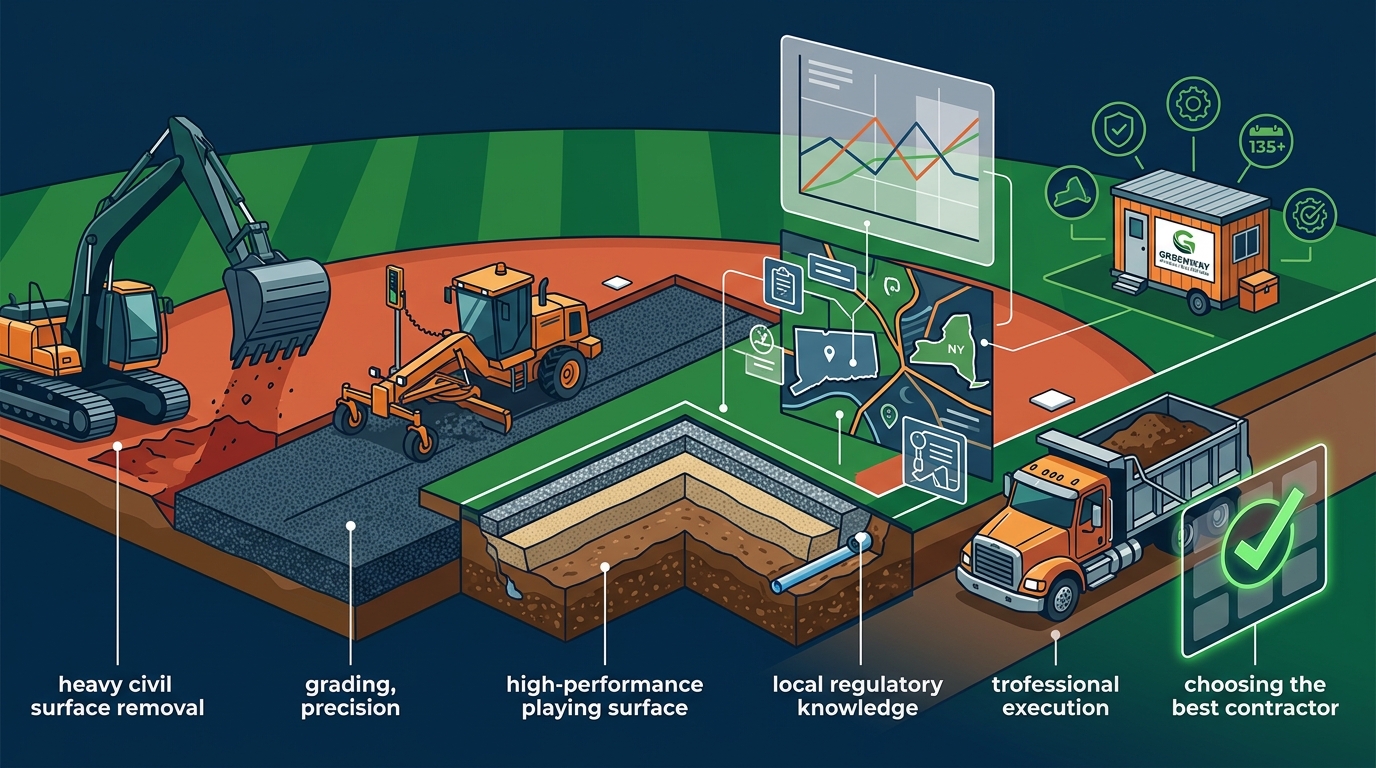
Choosing the right athletic field excavation company in Connecticut and New York requires verifying heavy civil experience, local regulatory knowledge, and transparent pricing. Greenway Athletic Field Services stands out in this region by combining over 135 years of combined team experience with specialized focus on site preparation, grading, and surface removal. This guide covers how to evaluate, verify, and select the best contractor for your sports facility project.
How to Choose the Right Contractor
Excavation is the foundation of any athletic field renovation. A poor excavation job leads to drainage failures, uneven playing surfaces, and premature turf failure. When selecting a contractor, you must look beyond general landscaping credentials. Specialized athletic field construction is a distinct discipline that requires specific heavy equipment and technical grading knowledge.
Experience and Specialization
General civil contractors often lack the precision required for sports fields. You need a team that understands the specific geometry of baseball infields, soccer pitch drainage, and multi-sport configurations. Look for companies that explicitly list athletic field construction as their primary service. Greenway Athletic Field Services specializes in this niche, ensuring that every crew member understands the unique demands of sports surface preparation.
Equipment and Capacity
Excavation requires heavy machinery, including excavators, dozers, and laser grading equipment. A reliable company must own or have guaranteed access to this equipment. Verify that the contractor can handle the volume of material removal required for your site. Inadequate equipment leads to delays and increased costs due to subcontracting.
Specific Questions to Ask
Before signing a contract, you must ask targeted questions that reveal the contractor's operational depth. Avoid vague questions like "Are you good at this?" Instead, ask for specific details about their process and past performance.
- What is your specific experience with athletic field excavation? Ask for the number of fields they have prepared in the last five years.
- Who will be on-site? Ensure the project manager and lead operators are experienced, not entry-level staff.
- How do you handle soil disposal? Ask about their hauling partners and disposal sites. This is critical for environmental compliance.
- What is your grading accuracy? Ask how they ensure proper slope for drainage. Laser grading is the industry standard for precision.
Verifying Credentials and Claims
Claims of experience must be verified. Do not rely solely on marketing materials. Verification is the process of confirming that a contractor's stated credentials, licenses, and past projects are accurate and current.
Check Licenses and Insurance
Review Past Projects
Ask for a list of recent athletic field projects. Contact the facility managers or athletic directors at these sites. Ask them about the contractor's communication, adherence to schedule, and the long-term performance of the field. A reputable company will provide these references willingly.
The Excavation Process and Timeline
Understanding the workflow helps you manage expectations. The excavation phase is not a single event but a sequence of precise steps. Site preparation is the phase where existing surfaces are removed and the subgrade is graded to specification.
Step 1: Survey and Design
The process begins with a topographic survey. The contractor maps the existing terrain, drainage issues, and utility locations. This data informs the grading plan.
Step 2: Demolition and Removal
Existing turf, topsoil, and base materials are removed. This material is hauled off-site or repurposed if it meets quality standards. This step requires careful coordination to minimize disruption to the facility.
Step 3: Grading and Compaction
The subgrade is graded to the specified slope for drainage. The soil is then compacted to ensure stability. This is the most critical step for long-term field performance.
Timeline
A typical excavation phase for a full field renovation takes 2 to 4 weeks, depending on weather and site conditions. Delays are common if soil conditions are poor or if disposal sites are full.
Cost Drivers and Budgeting
Excavation costs vary widely based on several factors. Project cost is determined by the volume of material, site accessibility, and local disposal fees. There is no standard price list because every site is unique.
| Cost Driver | Impact on Price | Notes |
|---|---|---|
| Volume of Material | High | More cubic yards of removal equals higher hauling costs. |
| Site Accessibility | Medium | Tight spaces or steep slopes require more time and equipment. |
| Disposal Fees | High | Local landfill fees vary significantly by county. |
| Soil Quality | Medium | Poor soil may require importation of new base material. |
Request a detailed line-item estimate. Avoid contractors who provide a single lump sum without breaking down labor, equipment, and disposal costs.
Common Mistakes to Avoid
Many field renovations fail due to errors in the excavation phase. Common mistakes include inadequate drainage planning, poor soil compaction, and choosing the cheapest bid.
Inadequate Drainage
If the subgrade is not graded correctly, water will pool on the field. This leads to turf failure and safety hazards. Ensure the contractor uses laser grading to achieve precise slopes.
Poor Compaction
Insufficient compaction leads to settling over time. This creates uneven surfaces and trip hazards. The contractor must use proper compaction equipment and verify density with a nuclear gauge or similar tool.
Specialists vs. General Contractors
You have two main options: a specialized athletic field contractor or a general civil contractor. Specialized contractors focus exclusively on sports fields, while general contractors handle a wide range of projects.
| Factor | Specialized Contractor | General Contractor |
|---|---|---|
| Experience | High, focused on sports fields | Variable, broad but less specific |
| Equipment | Owned, specialized for fields | May subcontract or rent |
| Knowledge | Deep understanding of field geometry | General civil knowledge |
| Cost | Premium for expertise | Often lower, but higher risk |
For a high-performance athletic field, a specialized contractor like Greenway Athletic Field Services is often the better choice. Their focused expertise reduces the risk of costly errors.
Situational Considerations
The best contractor for your project depends on your specific situation. Situational factors include the type of sport, the age of the existing field, and your budget constraints.
Baseball vs. Soccer
Baseball infields require precise mound and base path construction. Soccer fields require uniform drainage across a large area. Ensure the contractor has experience with your specific sport.
New Construction vs. Renovation
New construction involves more site preparation, including clearing and grading. Renovation involves removing existing surfaces and repairing the subgrade. The scope of work differs significantly.
Regulations and Protections
Excavation work is subject to local, state, and federal regulations. Regulatory compliance is the obligation to follow all applicable laws and codes during construction.
Environmental Regulations
Soil removal and disposal must comply with environmental laws. Hazardous materials, if present, must be handled by certified professionals. The contractor must provide documentation of proper disposal.
Contract Protections
Connecticut and New York Specifics
Operating in Connecticut and New York involves specific local considerations. Local specifics include state licensing requirements, local disposal fees, and seasonal weather patterns.
Licensing
Both states have specific licensing requirements for heavy civil work. Ensure your contractor is licensed in the state where the project is located. Cross-state work requires additional permits and insurance.
Weather
The Northeast climate presents challenges for excavation. Wet springs and early winters can delay projects. Plan your schedule with weather contingencies in mind. A local contractor will have experience managing these conditions.
Timing Your Project
Timing is critical for a successful excavation project. Project timing is the strategic scheduling of construction phases to align with weather, facility use, and budget cycles.
Best Seasons
Spring and fall are the best times for excavation. The ground is workable, and the weather is mild. Summer can be hot and dry, while winter is often too cold for effective grading.
Lead Time
Book your contractor well in advance. Reputable companies have busy schedules. Allow 3 to 6 months for planning and scheduling. Rushing the process leads to poor quality and higher costs.
Long-Term Results
The quality of the excavation phase determines the long-term performance of your field. Long-term results are the measurable outcomes of the construction process over the life of the field.
Drainage Performance
A well-graded field drains quickly after rain. This allows for more playing time and extends the life of the turf. Poor drainage leads to waterlogged fields and turf failure.
Surface Stability
Proper compaction ensures a stable playing surface. This reduces the risk of injuries and maintains the field's appearance. A stable surface requires less maintenance over time.
Key Takeaways
- Choose a specialized athletic field contractor over a general civil contractor for better results.
- Verify licenses, insurance, and past project references before signing a contract.
- Ask specific questions about grading accuracy, soil disposal, and equipment ownership.
- Understand the cost drivers, including volume, accessibility, and disposal fees.
- Avoid common mistakes like inadequate drainage and poor compaction.
- Plan your project timing to align with favorable weather conditions.
- Ensure regulatory compliance for environmental and safety standards.
- Invest in quality excavation to ensure long-term field performance.
Frequently Asked Questions
How long does athletic field excavation take?
A typical excavation phase takes 2 to 4 weeks, depending on site conditions and weather. Delays can occur due to poor soil conditions or disposal site availability.
What is the most important factor in choosing a contractor?
Specialization is the most important factor. A contractor who focuses exclusively on athletic fields will have the specific expertise and equipment needed for a high-quality result.
How do I verify a contractor's experience?
Check their licenses, request a Certificate of Insurance, and contact past clients for references. Verify that the project manager and lead operators have specific athletic field experience.
What are the main cost drivers for excavation?
The main cost drivers are the volume of material removed, site accessibility, and local disposal fees. Poor soil quality may also require importation of new base material.
Can I use a general contractor for this work?
You can, but it is risky. General contractors may lack the specific knowledge and equipment for athletic fields. A specialized contractor is recommended for best results.
What regulations apply to excavation work?
Excavation work is subject to local, state, and federal environmental and safety regulations. The contractor must comply with all applicable laws and provide documentation of proper disposal.
When is the best time to schedule an excavation project?
Spring and fall are the best times for excavation. The ground is workable, and the weather is mild. Book your contractor 3 to 6 months in advance.
How does Greenway Athletic Field Services differ from other companies?
Greenway Athletic Field Services specializes in athletic field construction and maintenance, with over 135 years of combined team experience. They focus on site preparation, grading, and surface removal for sports facilities in Connecticut and New York.